
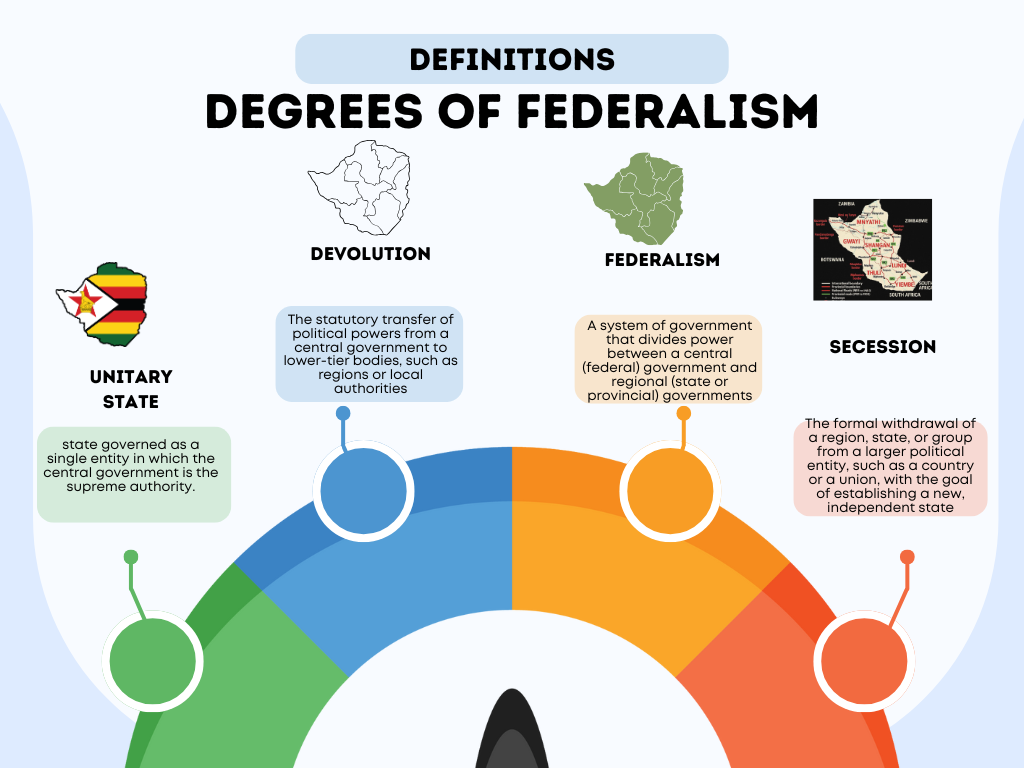
1. What is Federalism?
Federalism is a system of government in which power is constitutionally divided between a central (national) government and regional (state, provincial, or territorial) governments. Both levels of government have sovereignty in certain areas.
Examples:
- United States: States have powers over education, policing, taxation, etc.
- Nigeria, South Africa, Germany, India: Federal structures where provinces/states have their own legislatures and constitutions to varying degrees.
Key feature: The division of powers is constitutional and cannot be easily taken away by the central government without a constitutional amendment.
2. How does Federalism differ from Devolution?
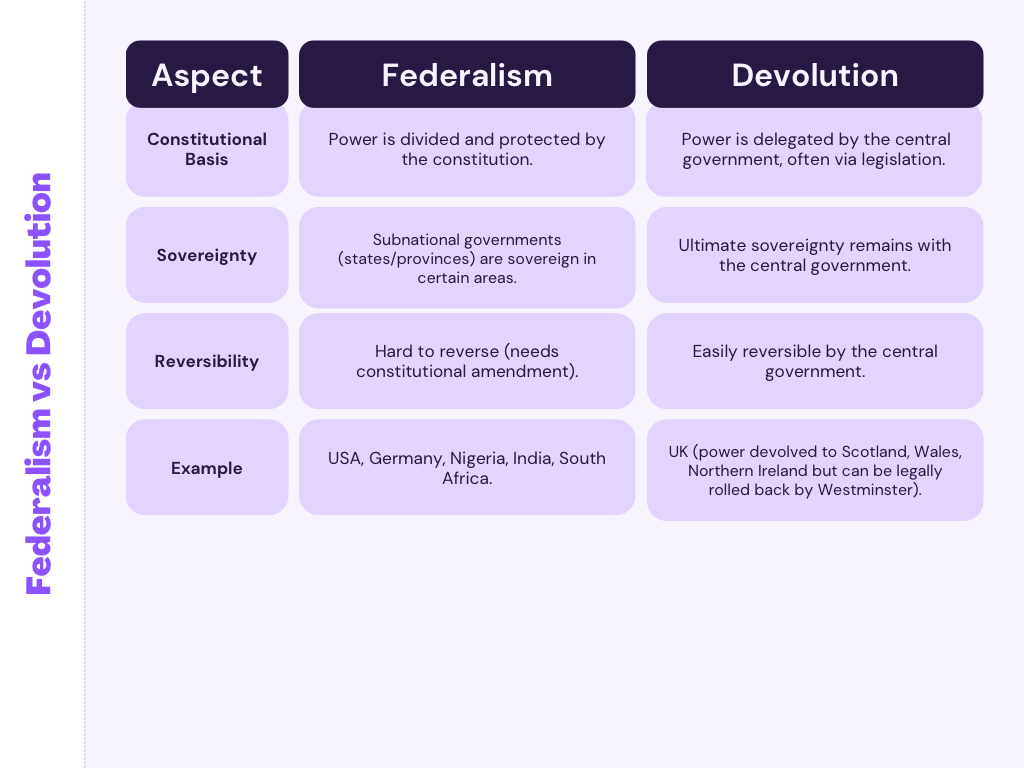
So: Federalism = shared sovereignty. Devolution = delegated authority.
3. Can Federalism work in Zimbabwe?
Zimbabwe is currently a unitary state. The 2013 Constitution allows for “devolution” (Chapter 14) but in practice, the central government retains tight control. Provinces have Provincial Councils but very little fiscal or legislative autonomy.
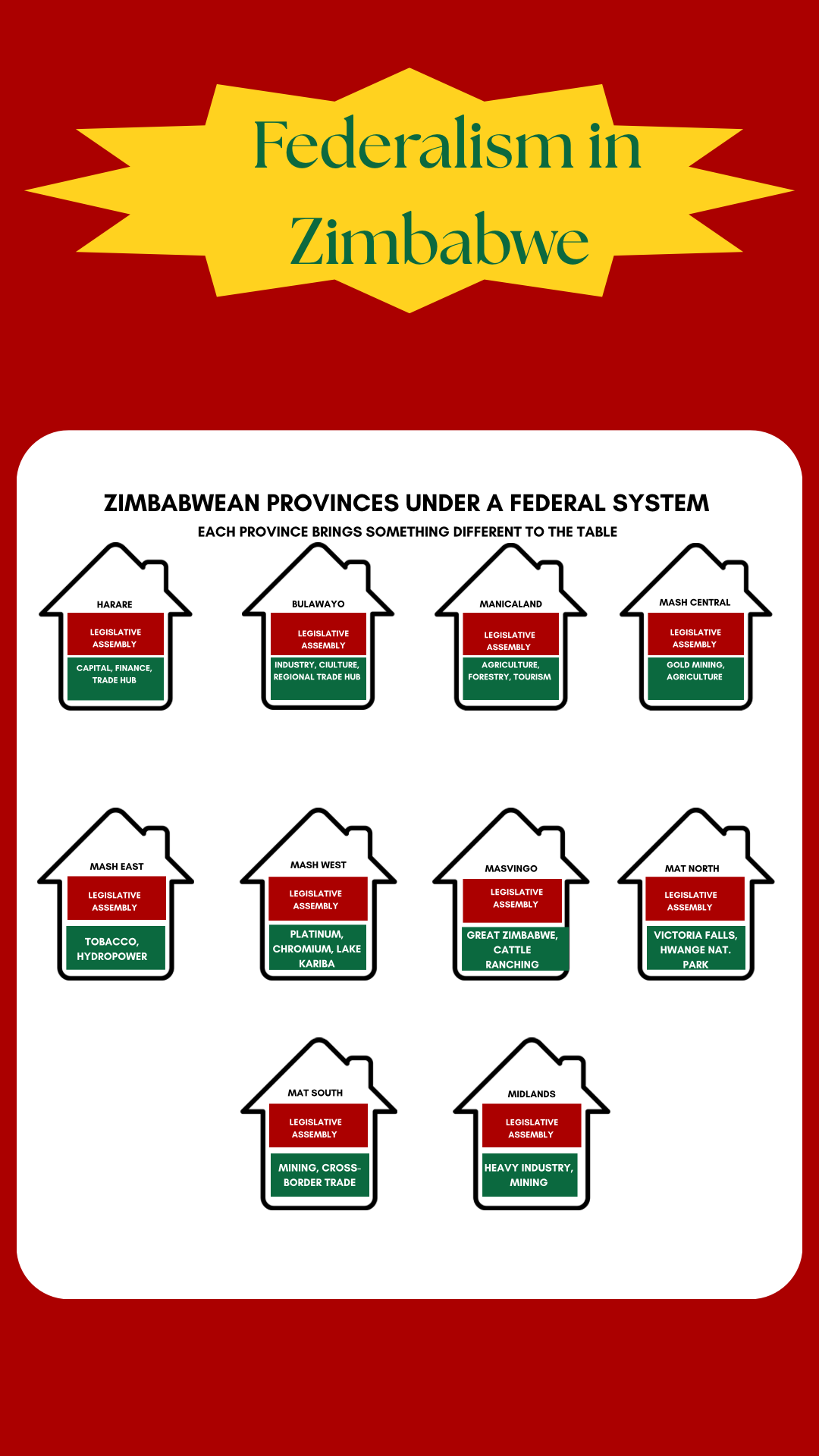
For federalism to work:
- The constitution would need restructuring to guarantee provinces/regions legal autonomy.
- Provinces like Matabeleland, Masvingo, Manicaland, Midlands would get more power over their own resources, budgets, and policies.
- National government would focus on “federal matters” like foreign policy, defense, currency, and national infrastructure.
Challenges:
- Political will: Current ruling elites benefit from centralization.
- Resource sharing: How to distribute wealth from resources (e.g., platinum in Mashonaland, gold in Midlands, agriculture in Manicaland, tourism in Matabeleland).
- Fear of secession: Federalism could be seen as a step towards breakaway states (e.g., Matabeleland grievances).
4. Will it improve the standard of living for the marginalised?
Potentially, yes – if properly implemented:
- Local accountability: Provincial governments closer to the people may respond better to needs (water, schools, roads).
- Resource control: Regions could manage and benefit from their own resources instead of relying on Harare.
- Reduced marginalisation: Provinces like Matabeleland, often neglected, could design policies to directly address local challenges.
- Economic innovation: Regions could try different development strategies instead of a one-size-fits-all policy from the capital.
But risks remain:
- Corruption: Federalism doesn’t automatically eliminate corruption—local elites could still capture resources.
- Capacity gaps: Some provinces might lack the skilled administrators to govern effectively at first.
- Unequal development: Wealthier provinces (e.g., with mineral wealth) may advance faster than poorer ones. A strong revenue-sharing formula would be essential.
✅ Bottom line:
- Federalism offers more permanent, constitutional power-sharing than devolution.
- In Zimbabwe, it could empower regions, address historical marginalisation, and improve standards of living if linked with transparency, strong institutions, and fair revenue distribution.
- But without political reform and safeguards against corruption, federalism alone won’t be a silver bullet.
 Hlosukwakha: We aim to build